

Effective New Jersey DUI defense tactics focus on challenging the legality of the traffic stop, questioning the accuracy of the Alcotest 7110 breathalyzer, and identifying procedural errors during the arrest. By scrutinizing these core elements, attorneys can often suppress evidence or negotiate favorable resolutions. The Law Office of Edward Appel applies these strategies to protect clients across all 21 New Jersey counties.
Challenging the Initial Traffic Stop
The foundation of many successful DUI defenses is the legality of the initial police contact. A motor vehicle stop is a seizure under the Fourth Amendment, meaning officers must have a valid reason to pull a driver over. If the stop lacks probable cause or reasonable suspicion, any evidence gathered afterward may be inadmissible.
Attorneys review dashcam footage and police reports to determine if the officer had a legitimate basis for the stop. Common issues include minor traffic violations that do not justify a full stop or observations that are too vague to establish suspicion of impairment. If the stop is found unlawful, the case may be dismissed entirely.
Questioning Alcotest Accuracy and Calibration
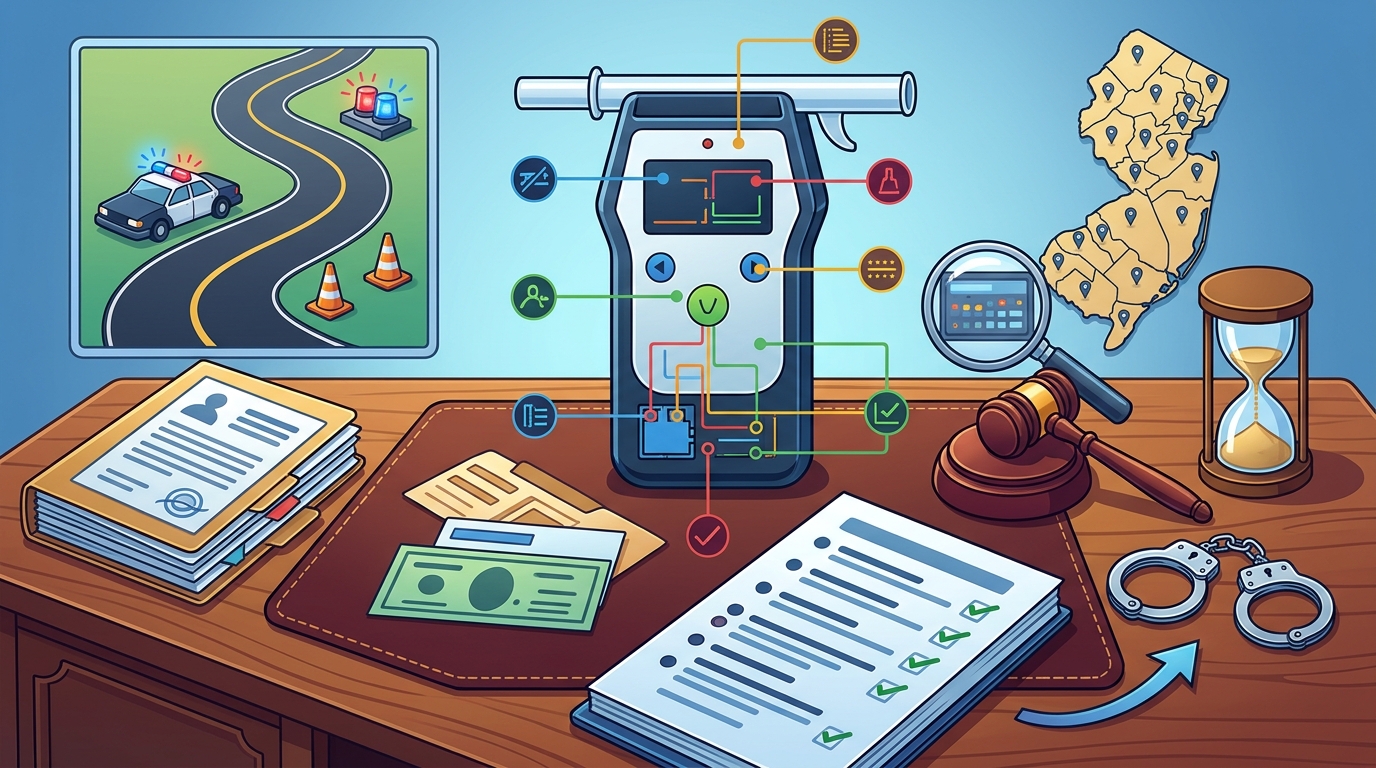
New Jersey relies on the Alcotest 7110 as its primary breath testing device. The Alcotest 7110 is a breathalyzer machine that measures alcohol concentration in a person's breath to estimate blood alcohol content. While the device is generally considered reliable, it is not infallible. Defense attorneys challenge the results by examining the device's maintenance and calibration records.
Specific protocols established in State v. Chun dictate how the device must be operated and maintained. If the operator failed to follow these protocols, or if the device was not calibrated correctly, the results can be challenged in court. This technical scrutiny often leads to reduced charges or favorable plea deals.
Evaluating Field Sobriety Test Reliability
Field sobriety tests (FSTs) are voluntary in New Jersey, and their results are often used to build probable cause for an arrest. However, these tests are subjective and can be influenced by environmental factors such as uneven pavement, poor lighting, or a driver's physical condition. An experienced defense attorney will argue that FST results are not scientific proof of impairment.
By highlighting inconsistencies in the officer's observations or the driver's physical limitations, lawyers can weaken the prosecution's case. This tactic is particularly effective when combined with challenges to the breath test results, creating a comprehensive defense strategy.
Navigating Refusal Charges and Penalties
Refusing a breath test in New Jersey triggers automatic license suspension and separate refusal charges. These charges are independent of the underlying DUI case, meaning a driver can face penalties even if the DUI charge is dismissed. Understanding the implications of refusal is critical for making informed decisions during a traffic stop.
Attorneys advise clients on the risks and benefits of submitting to or refusing the test. In some cases, a refusal may be the better strategic choice, while in others, providing a sample may lead to a more favorable outcome. The Law Office of Edward Appel provides clear guidance on these complex decisions.
Mitigating Long-Term Consequences
Even when a DUI charge cannot be fully dismissed, effective defense tactics can significantly reduce the long-term impact on a client's life. This includes negotiating for a lower grade of offense, reducing license suspension periods, or avoiding mandatory ignition interlock devices. These mitigations can preserve a driver's ability to work and maintain their insurance rates.
By focusing on these practical outcomes, attorneys help clients navigate the aftermath of a DUI arrest with minimal disruption. The goal is to protect the client's record and future opportunities while ensuring they receive a fair process in court.
Key Takeaways
- Challenging the legality of the traffic stop is a primary defense tactic in NJ DUI cases.
- The Alcotest 7110 results can be contested by reviewing calibration and operator protocols.
- Field sobriety tests are subjective and can be influenced by environmental factors.
- Refusal charges in NJ are separate from DUI charges and carry their own penalties.
- Effective defense can reduce long-term consequences like license suspension and insurance costs.
- Attorneys in NJ must be familiar with local court procedures and specific statutes like N.J.S.A. 39:4-50.
Frequently Asked Questions
Is a DWI a criminal offense in New Jersey?
No, a DWI is a motor vehicle offense, not a criminal offense. However, it carries severe penalties including license suspension, fines, and surcharges that can affect your life for years.
What are the penalties for a first DWI in NJ?
For a first offense with a BAC of 0.08-0.09%, the penalty is a 3-month suspension and a fine. For a BAC of 0.10% or higher, the suspension is 7-12 months with higher fines.
Can I keep my license after a DWI in NJ?
You may be able to obtain a restricted license for work or medical purposes, but a full license suspension is mandatory for a DWI conviction.
How long does a DWI stay on my record in NJ?
A DWI conviction remains on your driving record for 10 years. It may also appear on background checks for employment or housing.
Should I hire a lawyer for a traffic ticket in NJ?
For serious traffic offenses like DWI or driving while suspended, hiring a lawyer is highly recommended to protect your license and record.
What is the difference between reckless and careless driving in NJ?
Reckless driving is a more serious offense that can carry jail time, while careless driving is a minor point violation with no jail time.
Conclusion
Navigating a DUI charge in New Jersey requires a strategic and detailed approach to defense. By challenging the stop, questioning the Alcotest, and mitigating long-term consequences, attorneys can significantly improve the outcome for their clients. The Law Office of Edward Appel offers free, confidential consultations available 24/7 to help you understand your options. To discuss your case today, contact our team. Learn more: Contact Law Office of.