

Choosing the right New Jersey DUI attorney is critical for protecting your driving privileges after a first offense. The Law Office of Edward Appel provides specialized municipal court defense focused on challenging breath test evidence and navigating ignition interlock requirements. This guide explains how to evaluate legal representation and the specific strategies used to minimize license consequences under New Jersey law.
Understanding the NJ DUI Process
New Jersey treats driving under the influence as a motor vehicle offense handled in municipal court, not as a felony or misdemeanor crime. This distinction is vital because it dictates how license consequences are imposed. In most states, the Department of Motor Vehicles handles license suspensions administratively. In New Jersey, the municipal court judge imposes the license suspension as part of the criminal sentence upon conviction or a plea.
This means there is generally no separate administrative hearing to fight the license suspension before the court case concludes. The outcome of the criminal case directly determines your driving status. For a first offense, the court considers your blood alcohol concentration (BAC), whether you refused the breath test, and any aggravating factors like a crash or minors in the vehicle. Understanding this procedural framework is the first step in selecting an attorney who understands the specific mechanics of New Jersey municipal courts.
DUI/DWI Defense Strategies
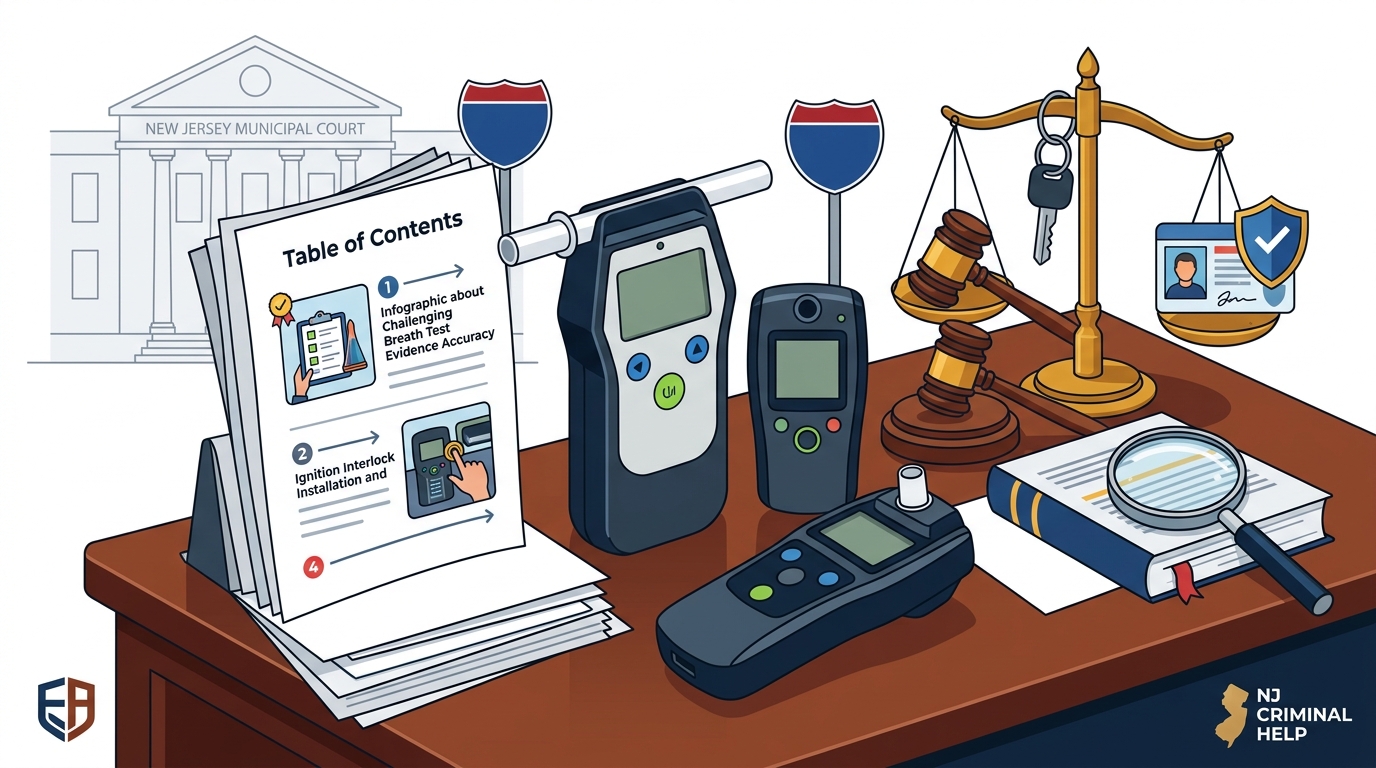
Effective defense in New Jersey requires a detailed understanding of the science behind breath testing and the legal standards for traffic stops. The Law Office of Edward Appel focuses on challenging the reliability of Alcotest 7110 results, which are the primary evidence in most DWI cases. An experienced attorney will review the calibration records, solution change logs, and operator certifications to identify procedural errors that may render the test results inadmissible.
Challenging the Traffic Stop
The foundation of any DUI defense is the legality of the initial traffic stop. If an officer lacked reasonable and articulable suspicion to initiate the stop, all evidence gathered thereafter may be suppressed. This includes field sobriety tests and breath test results. Attorneys must carefully review body-worn camera footage and dispatch logs to determine if the stop was lawful. An unlawful stop can lead to the dismissal of the entire case, protecting both your record and your license.
Field Sobriety Test Analysis
Standardized field sobriety tests (SFSTs) are subjective and often misinterpreted by officers. Defense attorneys evaluate whether the tests were administered correctly, considering factors such as footwear, injuries, weather conditions, and lighting. If the officer deviated from the standardized procedures, the results may be challenged. This technical scrutiny is a hallmark of a specialized DUI practice, distinguishing it from general criminal defense.
Medical and Environmental Factors
Certain medical conditions, such as GERD, diabetes, or recent dental work, can affect breath test readings. Additionally, mouth alcohol from recent consumption of certain products or medications can skew results. A thorough investigation into the client's medical history and recent activities can provide alternative explanations for elevated BAC readings. This requires an attorney who is willing to consult with forensic toxicologists and investigators to analyze the evidence in depth.
License Suspension Avoidance
Avoiding a license suspension after a first offense in New Jersey often hinges on the outcome of the criminal case and the specific BAC level. For first-time offenders with a BAC between 0.08% and 0.10%, the court may impose a suspension of 3 months, during which an ignition interlock device (IID) is required. If the BAC is 0.10% or higher, the suspension is typically 7 months, with the IID required for the entire period. If the defendant refuses the breath test, the suspension is 12 months, with the IID required for the entire period.
While a complete avoidance of suspension is difficult in cases with high BAC or refusal, an attorney can work to minimize the duration and impact. This includes negotiating for a shorter suspension period, challenging the validity of the breath test to lower the BAC classification, or seeking a dismissal based on procedural errors. The goal is to protect the client's ability to drive for work, family, and daily life while complying with the law.
Ignition Interlock Compliance
Ignition interlock devices (IIDs) are a central component of New Jersey DUI sentencing and restoration. Courts can require installation and may condition restoration or continued driving privileges on proof of installation and compliance. The IID prevents the vehicle from starting if the driver's breath sample exceeds a set BAC limit. Compliance is monitored by the New Jersey Motor Vehicle Commission (MVC), and non-compliance can result in additional penalties and extended suspension.
Attorneys advise clients on the practical aspects of IID installation and usage. This includes selecting a certified installer, understanding the device's requirements, and maintaining proper records. For commercial drivers or those with professional licensing issues, the impact of an IID and a DUI conviction can be severe. An attorney can help navigate these collateral consequences, providing guidance on disclosure requirements and potential alternatives where available.
| First Offense Scenario | Typical Suspension | Ignition Interlock Requirement | Key Defense Focus |
|---|---|---|---|
| BAC 0.08% - 0.099% | 3 months | Required for entire suspension | Challenging BAC accuracy |
| BAC 0.10% - 0.199% | 7 months | Required for entire suspension | Challenging stop and test |
| BAC 0.20% or higher | 12 months | Required for entire suspension | Medical/environmental factors |
| Refusal to Test | 12 months | Required for entire suspension | Challenging refusal validity |
Key Takeaways
- New Jersey DUI cases are handled in municipal court, where the judge imposes license suspensions.
- There is no separate administrative hearing to fight the license suspension before the court case.
- Challenging the legality of the traffic stop is a primary defense strategy.
- Procedural errors in breath testing can lead to suppression of evidence.
- Ignition interlock compliance is mandatory for most first-offense convictions.
- Medical conditions and environmental factors can affect breath test results.
- Collateral consequences include insurance premiums and employment issues.
- Early consultation with a specialized DUI attorney is critical for protecting your license.
Frequently Asked Questions
Can I avoid a license suspension for a first DUI in New Jersey?
It is difficult to completely avoid a suspension for a first DUI in New Jersey, especially with a high BAC or refusal. However, an attorney can work to minimize the duration and impact by challenging the evidence or negotiating a favorable resolution.
How long is a license suspension for a first DUI in NJ?
The suspension length depends on your BAC. For a BAC between 0.08% and 0.10%, it is 3 months. For 0.10% or higher, it is 7 months. For a refusal, it is 12 months.
Do I need an ignition interlock device for a first DUI?
Yes, New Jersey law requires an ignition interlock device for all first-offense DUI convictions. The device must be installed for the entire duration of the suspension.
What is the difference between a DUI and a DWI in New Jersey?
In New Jersey, the terms DUI and DWI are often used interchangeably, but the statute refers to the offense as DWI (Driving While Impaired). It is a motor vehicle offense handled in municipal court.
How can an attorney challenge a breath test result?
An attorney can challenge a breath test by reviewing the calibration records, operator certifications, and observation periods. They can also consult with forensic toxicologists to identify potential errors.
What are the collateral consequences of a DUI conviction?
Collateral consequences can include higher insurance premiums, employment issues, professional licensing problems, and immigration complications. An attorney can help you understand and navigate these impacts.
Is there a hardship license available in New Jersey?
No, New Jersey does not offer a hardship or restricted license during a DWI-related suspension. You must wait for the suspension to end or comply with the ignition interlock requirements.
Conclusion
Selecting the right New Jersey DUI attorney is a critical decision that can significantly impact your driving privileges and future. The Law Office of Edward Appel brings over 35 years of dedicated legal experience to your case, having personally represented more than 15,000 clients since 1988. Our focus on thorough preparation, challenging breath test evidence, and navigating municipal court procedures ensures that you receive the best possible defense. To plan your visit and discuss your case, for a confidential consultation.